Why Normalizing Flows (and Tensorizing Flows) deserve more attention
Supercharging Normalizing Flows by Tensor Networks as a Game-Changer for Scientific Machine Learning
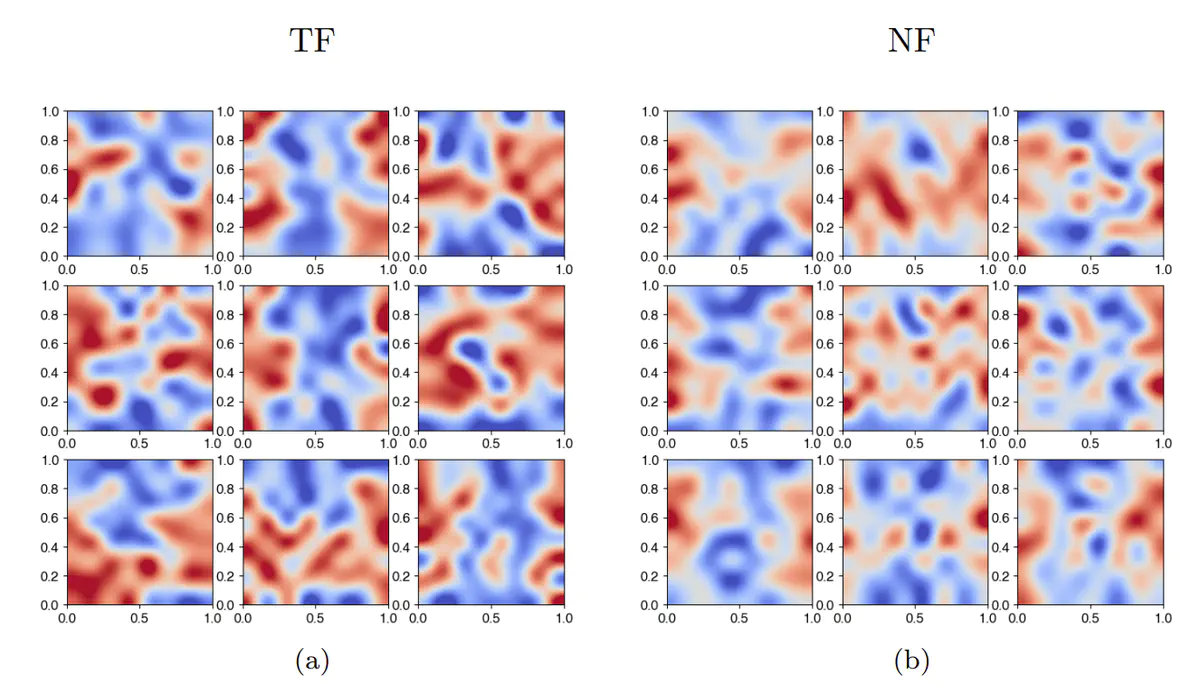
Other generative models like diffusion models and autoregressive LLMs tend to steal the spotlight, since they’re great at producing stunning images or generating text. Normalizing Flows, on the other hand, aren’t the first choice for those headline-grabbing tasks. But if you focus only on sample quality, you might overlook what makes Normalizing Flows truly valuable.
Why Normalizing Flows Deserve More Attention
Most generative models are black boxes. GANs, for example, can create high-quality samples, but you can’t compute the likelihood of a given data point. Energy-based models often only give you unnormalized densities, so you can compare samples but not get an actual probability.
Normalizing Flows are different. They let you map a simple base distribution (like a Gaussian) through a sequence of invertible transformations to model complex data. The kicker? You always have access to the exact, normalized probability density for any sample. This is a huge deal for applications where you need to know the likelihood, not just generate data.
The Real-World Use Case: Variational Inference
One area where this property is crucial is Variational Inference (VI). Here, you want to approximate a complex target distribution with a flexible, normalized family so you can do things like Bayesian inference efficiently. NFs are a natural fit because you can both sample from them and compute exact densities—something most other models can’t offer.
But There’s a Catch…
Traditional NFs use a Gaussian as their base distribution. This works fine for unimodal targets, but if your true distribution is multimodal (think: multiple peaks), NFs tend to “collapse” to just one mode. This limits their expressiveness in VI, especially for challenging scientific or physics problems where multimodality is the norm.
Enter Tensorizing Flows
The paper “Tensorizing Flows: A Tool for Variational Inference” introduces a clever fix: replace the Gaussian base with a tensor-train (TT) distribution, built using tools from tensor networks. This TT base can already capture much of the structure (including multimodality) of the target distribution, so the flow only needs to handle the “fine details.” The result is a model that’s both more expressive and easier to train for high-dimensional, multimodal problems.
Resources

Mahyar Osanlouy
Scientist | Engineer
My research interests include machine learning and computational neuroscience.