The Hitchhiker’s Guide to Rebranding Machine Learning (And a Shoutout to Geoff Hinton!)
How to Sound Like a Physicist When You’re Really Just Doing Machine Learning
Ever feel like the world of machine learning is just a little too… techy? Well, let’s give that jargon a fresh coat of paint; one with a physics twist.
Welcome to my Hitchhiker’s Guide to Rebranding Machine Learning! 🚀
Let’s face it: sometimes, explaining ML to your friends sounds like you’re reading from a sci-fi manual. So, why not embrace it? Here’s my tongue-in-cheek translation table for the next time you want to sound like a quantum physicist at a data science meetup:
-
Machine learning? Nah, let’s call it statistical mechanics.
-
Loss function? That’s just an energy functional.
-
Optimize the model? We’re really just minimizing free energy.
-
Trained model? You’ve simply reached equilibrium distribution.
-
KL divergence? That’s the free energy difference, obviously.
-
Gaussian noise? Those are just random thermal fluctuations.
-
Random step? Welcome to Brownian motion.
-
SGD? Think of it as directional Brownian motion.
-
GPU? Basically a simulated particle accelerator.
-
Diffusion models? That’s Langevin dynamics for you.
-
LLM (Large Language Model)? Try high-order discrete Markov chain on for size.
-
NLP? Let’s call it “string theory” (because why not?).
-
Reinforcement learning? That’s just control theory.
-
Robotics? It’s all physical computation.
-
Audio learning? 1D signal processing.
-
Image learning? 2D signal processing.
-
Video learning? You guessed it: 3D signal processing.
-
Multimodal models? We’re talking multidimensional signal processing.
You’re welcome. 😉
A Quick Geek-Out: Congrats to Geoff Hinton!
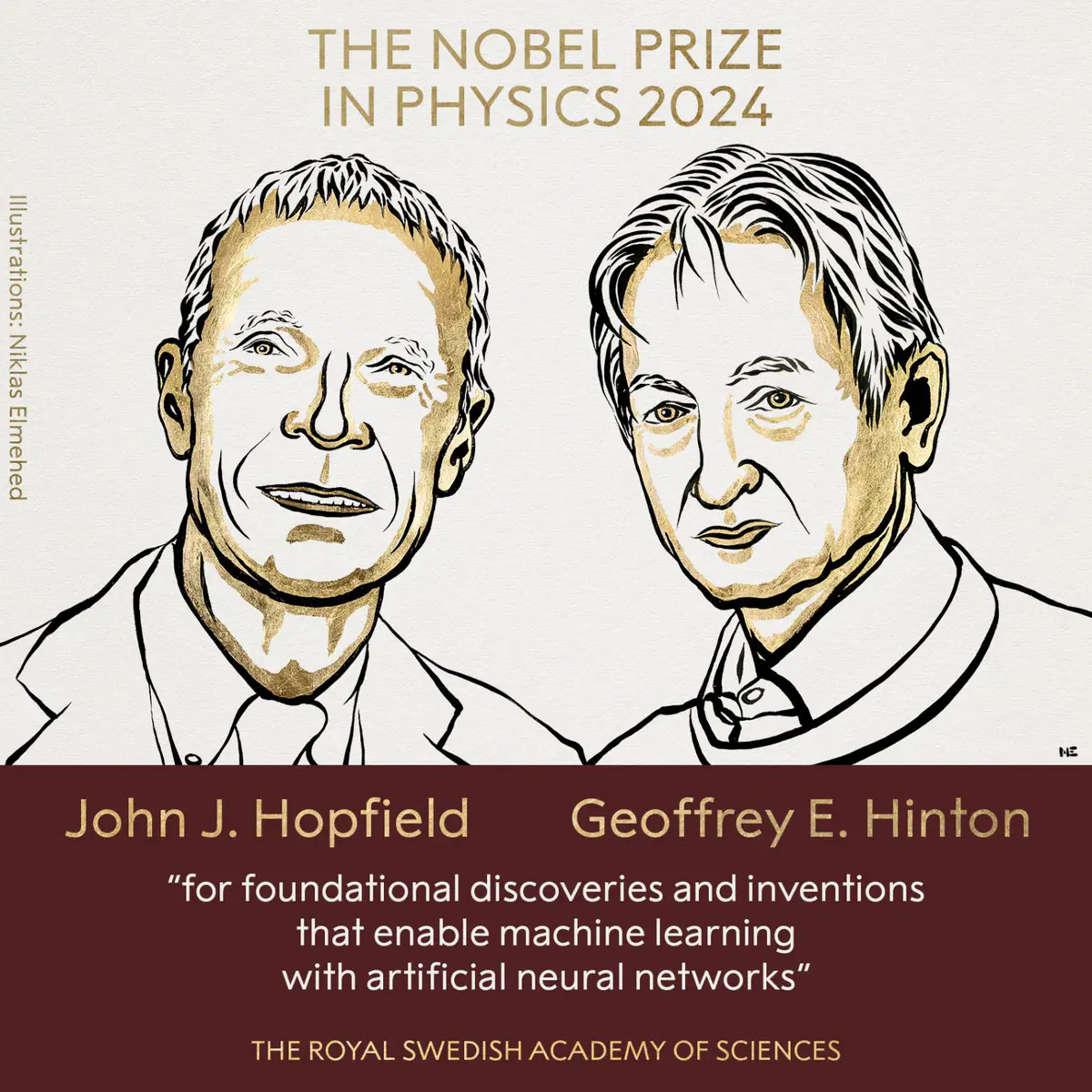
Before I wrap up, I have to give a huge shoutout to Geoff Hinton, who just became the second person ever to win both the Turing Award and a Nobel Prize! (Herbert A. Simon was the first, winning in Economics.) Legends, both of them.
So, the next time someone asks what you do, feel free to say you’re working on “minimizing free energy in high-order discrete Markov chains using simulated particle accelerators.” If nothing else, you’ll sound like you’re saving the universe.
Mahyar Osanlouy
Scientist | Engineer
My research interests include machine learning and computational neuroscience.